top

Seed directions for a greener Future

The motto of VE.PLANT education: 'Seed directions for a greener Future'

Education is the key

VE.PLANT brings the solution for learning and knowledge transfer in educational institutions. By providing a vertical hydroponic planting system based on programmable microcontrollers, it is now possible for the first time to conduct resource-efficient, sustainable teaching about plants and healthy nutrition year-round. Through educational workshops, students can broaden their horizons together using the VE.PLANT planting system. This promotes not only knowledge in subjects such as biology, chemistry, physics, and computer science, but also social skills for coordination, care, and harvesting. THE PATH TOWARD A SUSTAINABLE & GREENER DEVELOPMENT OF SOCIETY BEGINS WITH OUR FUTURE GENERATION! Discover our educational offerings in the following section and secure your appointment today.

Our Courses

VE.GROHY TOGETHER Kids (incl. VE.PLANT planting system)
Grade 5-9
2x 4 hours
up to 30 students
Key points
  • Plant growth (Light, water, nutrients)
  • Conventional farming vs Organic famring vs Hydroponics
  • Teamwork in setting up a VE.PLANT planting system
  • Illustrated worksheets and exercises
  • Each student receives a mini VE.PLANT, including cress seeds, for their own experiments
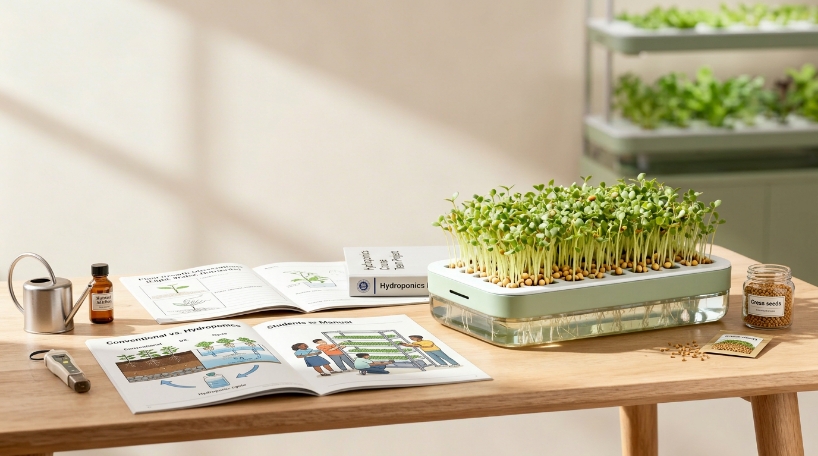
An image showing a desk with a hydroponic system on it. Additionally, learning materials about hydroponics and plant growth are laid out on the table. In the background, there is another hydroponic planting system.
Description
This course is designed to take place over two days. First, students are introduced to the topics of plant growth and hydroponics through theory. Practical exercises and illustrative worksheets help reinforce and apply what they have learned.

On the second day, the VE.PLANT planting system is assembled together and planted. In the process, students can demonstrate their teamwork skills and learn how the system is constructed. The VE.PLANT system serves as a teaching tool and remains at the educational institution afterward.

At the end, each participant receives a mini VE.PLANT to take home. There, they will plant cress or microgreens together, and everyone can apply what they’ve learned in a practical way on their own.
Get in touch now
VE.GROHY TOGETHER Kids
Grade 5-9
4 hours
up to 30 students
Key points
  • Plant growth (Light, water, nutrients)
  • Conventional farming vs Organic famring vs Hydroponics
  • Illustrated worksheets and exercises
  • Each student receives a mini VE.PLANT, including cress seeds, for their own experiments
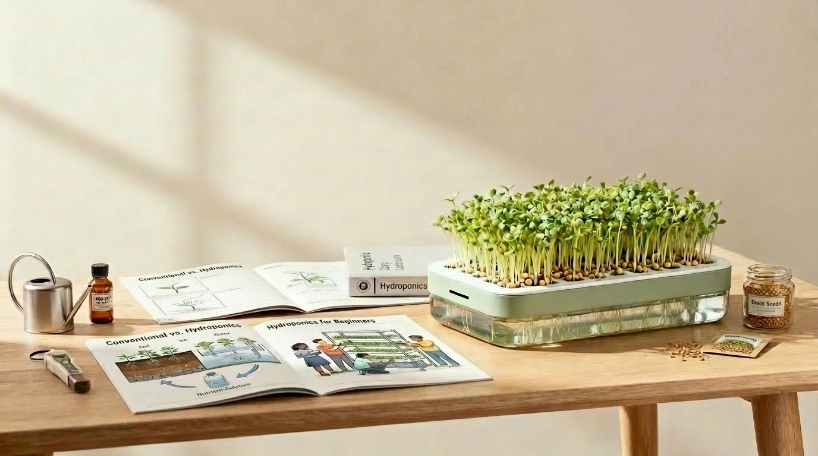
An image showing a desk with a hydroponic system on it. Additionally, learning materials about hydroponics and plant growth are laid out on the table.
Description
This course enables students to explore the topics of plant growth and hydroponics in an engaging and hands-on way. The theoretical foundations are taught clearly and in an age-appropriate manner, allowing participants to develop a solid understanding of these future-relevant topics.

A particular focus is placed on the comparison between conventional cultivation and hydroponics. Students learn about the principles of traditional plant growing and discover how the innovative method of hydroponics differs from it. The advantages and disadvantages of both approaches are examined to foster a comprehensive understanding of sustainable and modern growing methods. Through practical exercises and interactive learning materials, the acquired knowledge is deepened and directly applied.

The highlight of the course is the mini VE.PLANT set that each participant receives at the end of the course. Together, the students plant cress or microgreens, giving them the opportunity to practically apply and further explore what they have learned at home. This fosters not only understanding, but also enthusiasm for sustainable and innovative growing methods.
Get in touch now
VE.GROHY TOGETHER Electrical engineering
Grade 5-12
4 hours
up to 30 students
Key points
  • Teaching fundamental understanding of electrical circuits
  • Practical introduction to soldering
  • Each student will independently solder a small electrical component under supervision. These are typically functional after the course. Examples include kits such as a mason jar solar lamp, a "steady hand game" (hot wire), or a blinking Christmas tree.
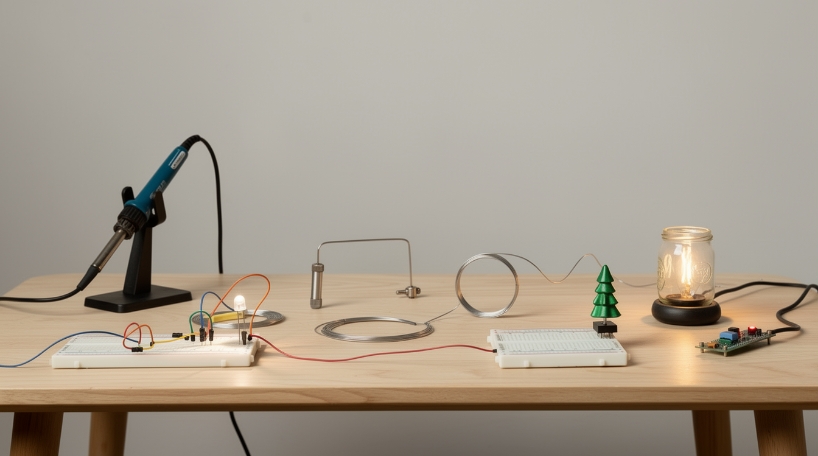
An image showing a desk with electronic crafting components on it.
Description
This course offers students the opportunity to discover the fascinating world of electrical engineering and gain their first hands-on experience in soldering.

Participants receive an age-appropriate introduction to the fundamentals of electrical circuits. A basic understanding of how circuits function and are structured is conveyed. This is followed by a practical introduction to soldering, during which students learn soldering techniques and safety aspects under expert guidance.

A particular highlight of the course is the hands-on implementation: each student independently solders a pre-made kit, such as a mason jar solar lamp, a "steady hand game" (hot wire), or a blinking Christmas tree. At the end of the course, participants leave with a fully functional end product they can take home.

Important note: Soldering is carried out exclusively under the supervision of instructors and/or supervisors to ensure the safety of students at all times.

This course not only fosters technical understanding and practical skills, but also sparks enthusiasm for electrical engineering and demonstrates how creatively and practically this knowledge can be applied.
Get in touch now
VE.GROHY TOGETHER IT
Grade 9-12
6 hours
up to 30 students
Key points
  • Teaching theoretical fundamentals of hydroponics and automation
  • How does IoT work according to Industry 4.0 standards?
  • Programming a sensor and achieving results with the sensor kit in teamwork
  • Automation of the lighting of a mini VE.PLANT including reading sensor values
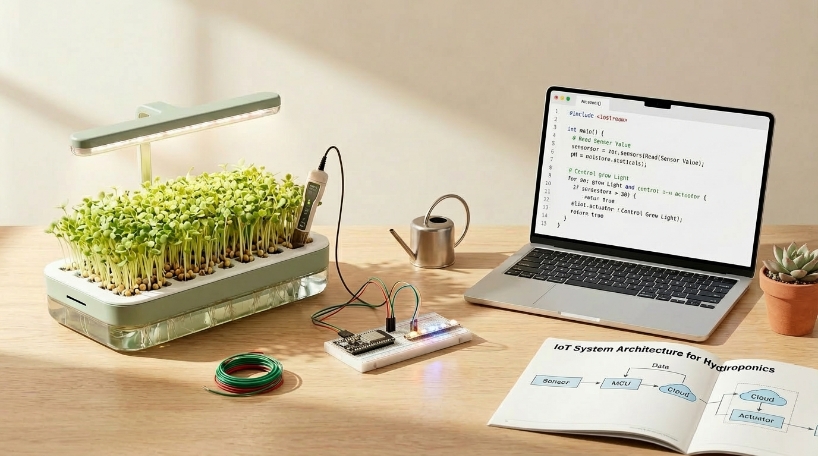
An image showing a desk with a hydroponic system controlled by a microcontroller.
Description
This course offers students an exciting introduction to the world of hydroponics, automation, and microcontroller programming in the context of IoT and Industry 4.0.

Participants first receive a theoretical introduction to the fundamentals of hydroponics and automation. This covers how modern technologies can be applied in agriculture and how the Internet of Things (IoT) works according to Industry 4.0 standards.

In the practical part of the course, students work in teams on a sensor kit. Together they program sensors, automate the lighting of a mini VE.PLANT, and read various sensor values. These values are then visualized on a display, allowing students to directly track the results of their work. The course promotes not only technical understanding, but also teamwork and problem-solving skills.

Important notes:
  • The sensor kits and mini VE.PLANT sets do not remain at the educational institution, but can be purchased for an additional fee on top of the course price.
  • The course requires one laptop or PC per team on-site, on which the course instructors can install software. Alternatively, laptops can be provided by the course instructors, though this comes with an additional surcharge.

This course combines innovative technologies with practical applications and sparks enthusiasm for the possibilities of modern automation and programming.
Get in touch now